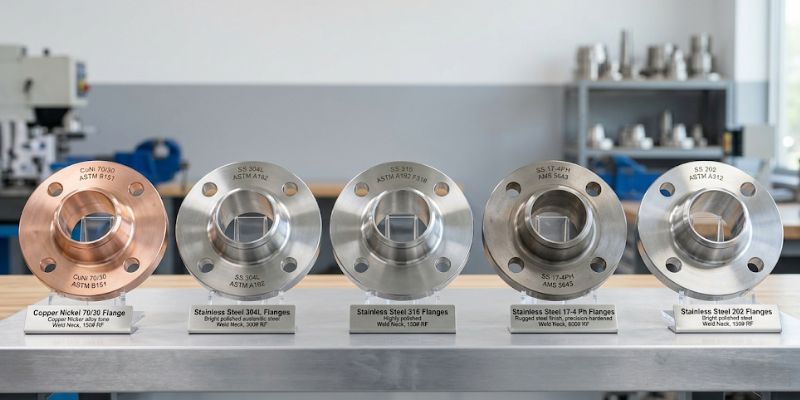
In today’s competitive industrial landscape, selecting the right flanges is essential for ensuring efficiency, durability, and long-term cost savings. Buyers across sectors such as oil & gas, chemical processing, and construction rely on trusted sourcing channels like Pipex.ai, a leading B2B platform that connects them with verified suppliers and quality-certified products. Understanding material grades, corrosion resistance, and supplier credibility helps buyers make informed procurement decisions and avoid costly operational failures.
Copper Nickel 70/30 Flange
Copper Nickel 70/30 Flanges are widely used in marine and offshore applications due to their excellent resistance to seawater corrosion and biofouling. Buyers often prefer sourcing from a reliable Copper Nickel 70/30 Flange Manufacturer to ensure superior material quality and compliance with global standards. These flanges provide excellent thermal stability and long service life, making them ideal for shipbuilding, desalination plants, and heat exchanger systems where reliability is critical.
Key considerations:
• Corrosion resistance in marine environments
• Compliance with international standards
• Mechanical strength and durability
• Supplier reliability and certifications
Stainless Steel 304L Flanges
Stainless Steel 304L Flanges are highly preferred for applications requiring strong corrosion resistance and excellent weldability. Buyers typically choose a trusted Stainless Steel 304L Flanges Supplier to ensure low carbon content and high-quality finishing. These flanges are suitable for industries such as food processing, pharmaceuticals, and chemical plants, where hygiene and corrosion resistance are crucial. Their versatility and affordability make them a popular choice among industrial buyers.
Key considerations:
• Low carbon composition for weldability
• Resistance to oxidation and corrosion
• Surface finish and dimensional accuracy
• Supplier quality assurance
Stainless Steel 316 Flanges
Stainless Steel 316 Flanges are known for their superior corrosion resistance, particularly in chloride-rich and harsh environments. Buyers sourcing from a trusted Stainless Steel 316 Flanges Exporter benefit from materials that perform reliably in marine, chemical, and pharmaceutical industries. The addition of molybdenum enhances resistance to pitting and crevice corrosion, making these flanges ideal for demanding applications where durability and performance are essential.
Key considerations:
• Resistance to chloride corrosion
• High durability in harsh conditions
• Certification and export standards
• Application-specific suitability
Stainless Steel 17-4 PH Flanges
Stainless Steel 17-4 PH Flanges are high-strength, precipitation-hardening alloys designed for critical industrial applications. Buyers often rely on experienced Stainless Steel 17 4 Ph Flanges Dealers to ensure proper heat treatment and consistent mechanical properties. These flanges offer excellent strength, hardness, and corrosion resistance, making them suitable for aerospace, petrochemical, and high-pressure systems where performance and reliability cannot be compromised.
Key considerations:
• High strength and hardness
• Heat treatment and processing quality
• Resistance to corrosion and stress cracking
• Trusted dealer network
Stainless Steel 202 Flanges
Stainless Steel 202 Flanges are cost-effective solutions for applications requiring moderate corrosion resistance and strength. Buyers working with a dependable Stainless Steel 202 Flanges Stockist can ensure steady availability and consistent product quality. These flanges are commonly used in construction, structural frameworks, and general engineering applications due to their affordability and practical performance in non-critical environments.
Key considerations:
• Cost-effectiveness for bulk usage
• Availability and stock consistency
• Adequate mechanical strength
• Supplier inventory reliability
Conclusion
Choosing the right flanges requires a balance between performance, cost, and supplier credibility. Buyers must evaluate material specifications, certifications, and application suitability before making procurement decisions. Partnering with a reliable industrial marketplace ensures access to verified suppliers, competitive pricing, and consistent product quality. With the right sourcing strategy, businesses can enhance operational efficiency, reduce maintenance costs, and ensure long-term project success.